

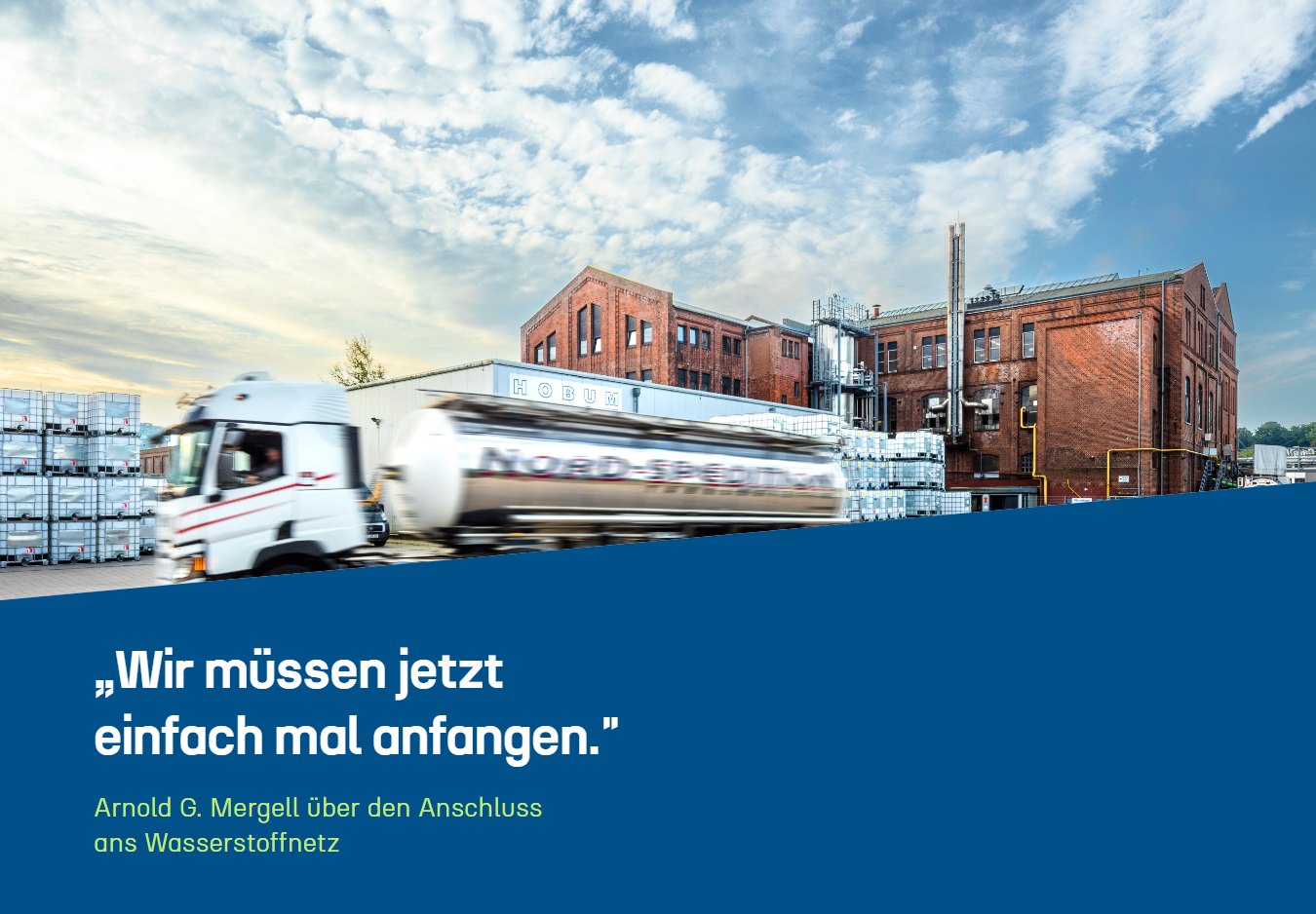
HOBUM Oleochemicals GmbH will connect its Harburg site to the emerging hydrogen network next year. The connection creates the conditions for using the technology in production later on. Hydrogen still costs far more than established energy carriers today. Arnold G. Mergell, managing partner of HOBUM, told Tobias Pusch for Business & People why the step makes sense anyway.
Turning vegetable oils and fats into chemical intermediates is energy intensive. From these raw materials HOBUM makes intermediates for coatings, adhesives, sealants and elastomers. Many process steps require high temperatures and large volumes of steam. "Electrifying an industrial society is not trivial," Mergell says. He does not treat hydrogen as a competitor to other technologies. He treats it as an additional option, and his argument is redundancy. Depending on a single energy carrier or a single supplier is a supply risk in itself. He does not dispute that hydrogen currently costs a factor of five to seven more than established energy carriers. He does dispute the conclusion that the technology therefore has no future. Technologies become cheaper and more efficient as they spread. The connection sits within the climate targets of HOBUM, which follow the Science-based Targets Initiative. For scope 1 and 2 that means 42 per cent less by 2030, against the 2020 base year.
Mergell is also deputy chairman of the Wirtschaftsverein für den Hamburger Süden. Through the HY NOON series and the hydrogen symposium, the association brings together companies, research, policymakers and grid operators. For Mergell the connection is above all an investment in room to manoeuvre. He expects that a product will soon be judged on its footprint, not only on its price. Whoever builds the conditions early will have the wider options later. "We simply have to start now," Mergell says. The magazine is free of charge as a PDF in the publisher archive, and it is written in German. The full article is on page 14 of Business & People II/26.